


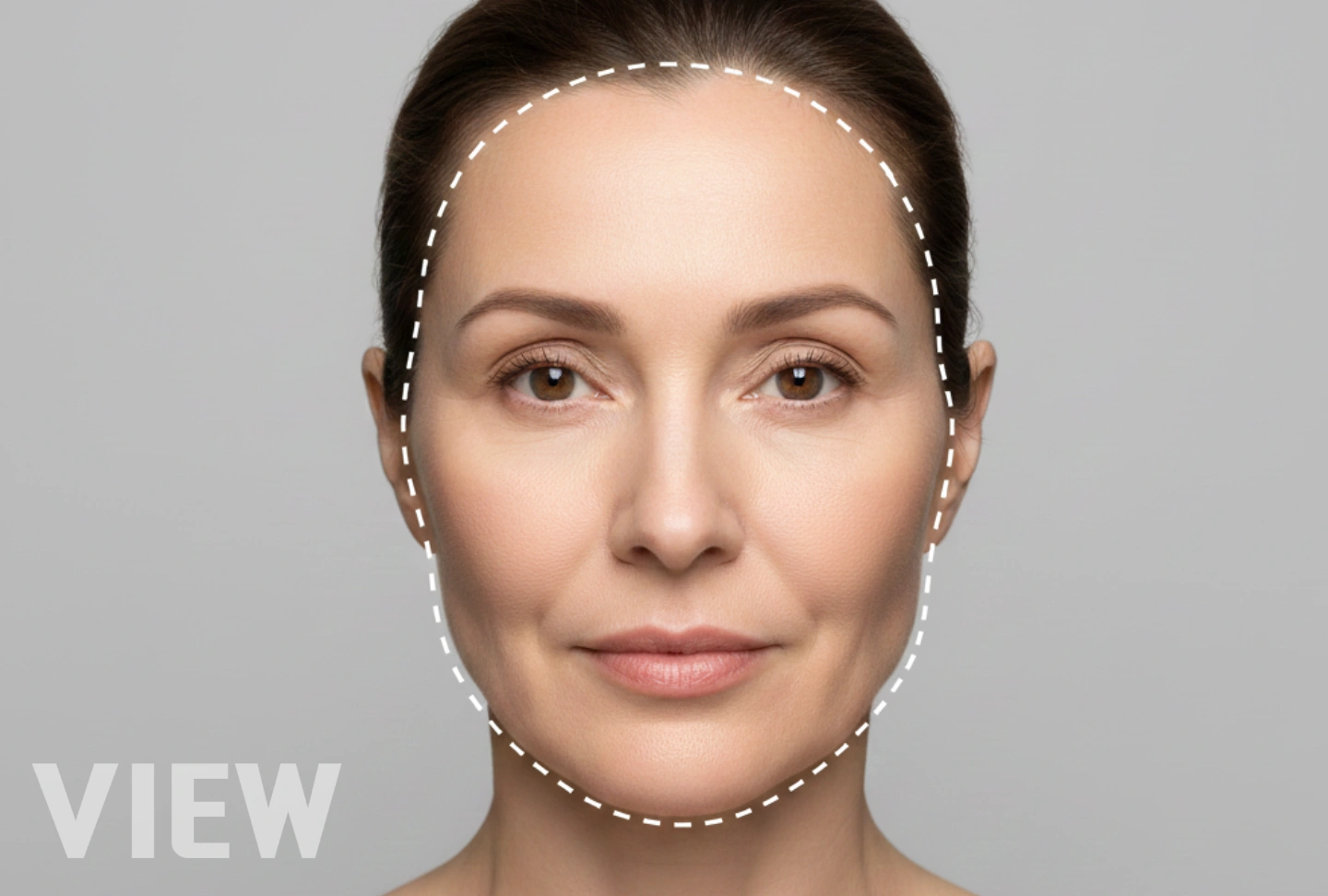
At View Plastic Surgery, we analyze the face not as isolated zones but as a composite of structural layers. The most effective protocol for correcting a peanut shaped face involves a triad of treatments: Midface/Thread Lifting to reposition tissues, Structural Fat Grafting to restore volume, and Stem Cell Therapy to ensure graft survival and skin regeneration.
The Anatomy of the Peanut Shaped Face: Why It Happens
To treat the condition, one must understand the underlying pathology. A peanut shaped face is generally caused by a combination of skeletal structure and soft tissue atrophy.
- Temporal Hollowing: Loss of the temporal fat pad creates a concave appearance in the upper third of the face.
- Sub-Malar Hollows: Below the cheekbones, the buccal fat pad may atrophy or descend, creating a gaunt look.
- Zygomatic Prominence: When surrounding tissues lose volume, the cheekbones appear overly wide and aggressive.
As we age, the midface soft tissues descend due to gravity and the loosening of retaining ligaments. This descent creates nasolabial folds and exacerbates the hollows under the eyes (tear troughs). Therefore, merely filling the hollows without addressing the descent can lead to an unnatural, heavy lower face. This is why a lifting component is crucial.
The First Pillar: Midface Lifting & Tissue Repositioning
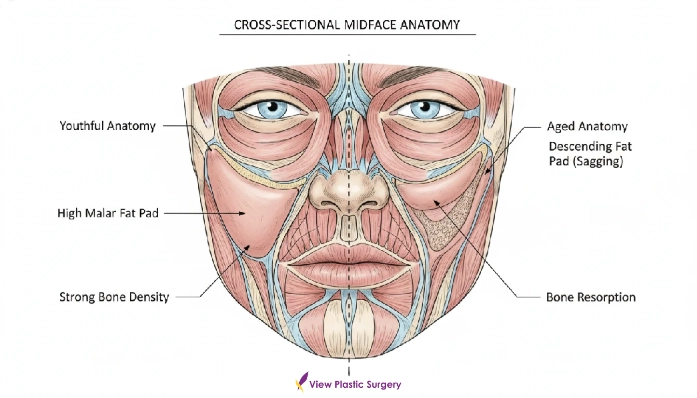
The foundation of correcting a peanut shaped face is repositioning the fallen malar fat pad. We utilize advanced lifting techniques to restore the structural framework.
While deep plane facelifts are available for severe aging, many patients aiming for correction of the peanut shape benefit significantly from minimally invasive Thread Lifting. By inserting medical-grade threads (PDO/PLLA) into the SMAS layer, we can physically pull the sagging midface tissues upward and inward. This eliminates the need for excessive filler volume by utilizing the patient’s existing tissues to cover the cheekbones properly.
For a detailed assessment of which lifting technique suits your bone structure, we recommend a private consultation.
The Second Pillar: Structural Fat Grafting
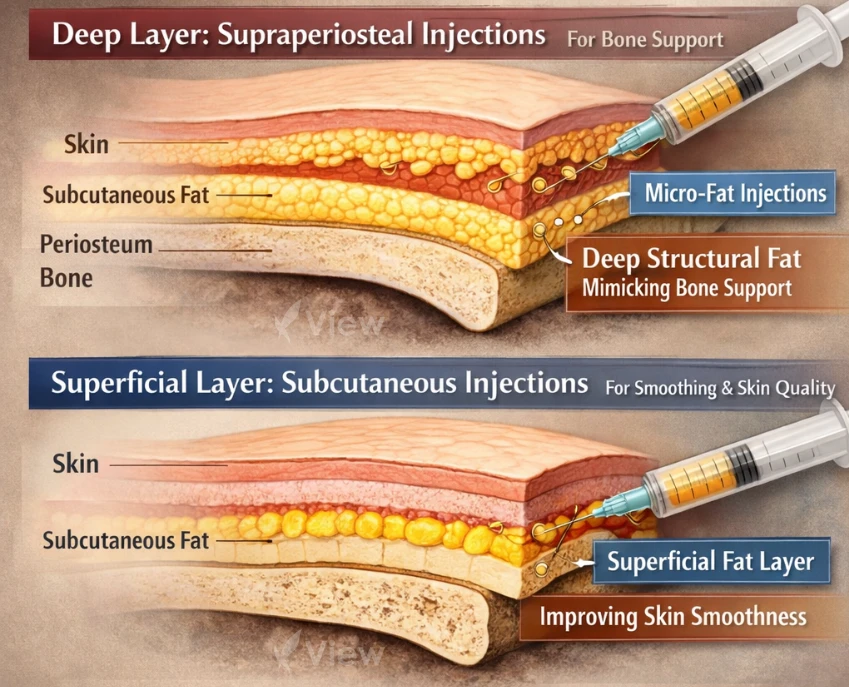
Once the tissues are lifted, the remaining concave areas—specifically the temples and deep cheek hollows—must be addressed. Unlike synthetic fillers, autologous fat grafting offers a permanent, biocompatible solution.
We harvest fat from the thighs or abdomen, purify it to remove oil and blood, and inject it as micro-fat. The key is structural layering:
- Deep Layer: Supraperiosteal injections to mimic bone structure and support the skin.
- Superficial Layer: Subcutaneous injections to smooth transitions and improve skin quality.
This technique avoids the “overfilled” look by respecting facial boundaries, turning the sharp angles of a peanut face into the soft curves of an egg-shaped face.
The Third Pillar: Stem Cell Therapy (The Game Changer)
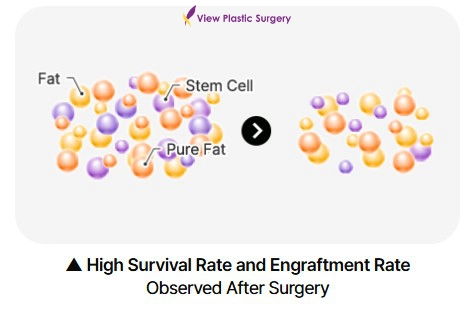
The most significant challenge in fat grafting is resorption—the body absorbing 30-50% of the injected fat. This is where Stem Cell Therapy becomes the critical differentiator at View Plastic Surgery.
We isolate Stromal Vascular Fraction (SVF) containing Adipose-Derived Stem Cells (ADSCs) and mix this with the fat graft. This process provides three distinct medical advantages:
| Benefit | Mechanism of Action | Clinical Outcome |
|---|---|---|
| Enhanced Angiogenesis | Stem cells stimulate new blood vessel formation around the grafted fat. | Significantly higher fat survival rates (up to 70-80%), reducing the need for secondary touch-ups. |
| Skin Quality Improvement | Regenerative signaling improves collagen and elastin production. | Reduction in fine lines, pore size, and dark circles; the “Stem Cell Glow.” |
| Accelerated Recovery | Anti-inflammatory properties of SVF reduce edema and bruising. | Faster downtime, essential for international patients with tight travel schedules. |
Learn more about our advanced regenerative protocols on our Stem Cell Therapy page.
Synergistic Effects: Why Combine Them?

Treating a peanut-shaped face is not about choosing between lifting or filling—it is about the synergy of both.
- Without Lifting: You would need excessive fat volume to fill the hollows, leading to a “puffy” or “pillow” face.
- Without Fat: Lifting alone tightens the skin but does not correct the skeletal hollowness or temporal wasting.
- Without Stem Cells: The fat may reabsorb unevenly, leading to asymmetry or calcification.
By combining these, we achieve the “Baby Face” contour: wide, smooth temples, soft cheeks, and a tight, defined jawline.
Ideal Candidates
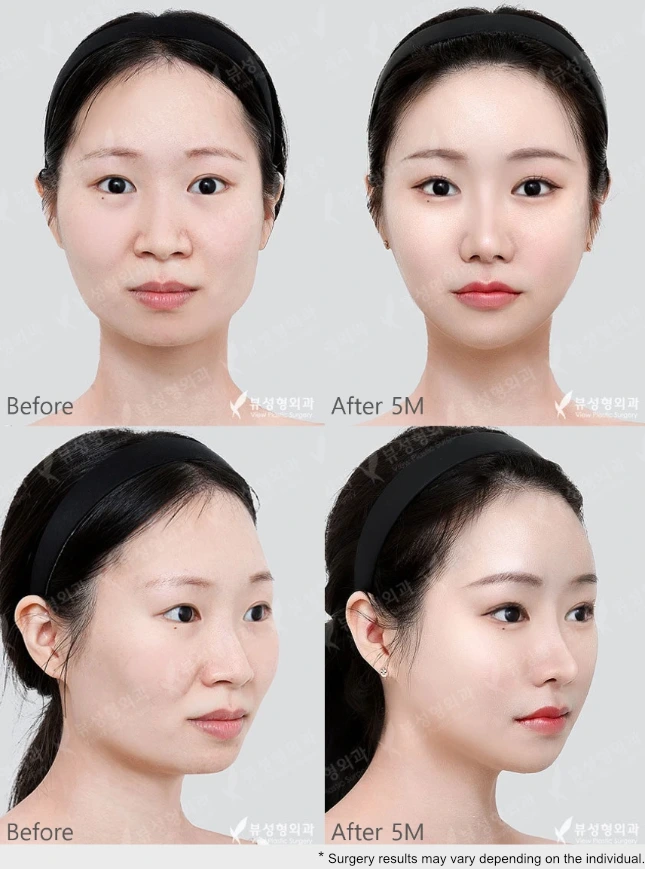
This multimodal approach is best suited for:
- Patients with prominent zygomas (cheekbones) and hollow temples.
- Individuals experiencing midface sagging (deep nasolabial folds).
- Those seeking natural rejuvenation without the “plastic” look of excessive fillers.
- International patients who need long-lasting results in a single trip.
If you are unsure if you are a candidate, you can send your photos directly to our medical team via WhatsApp for a preliminary evaluation.