


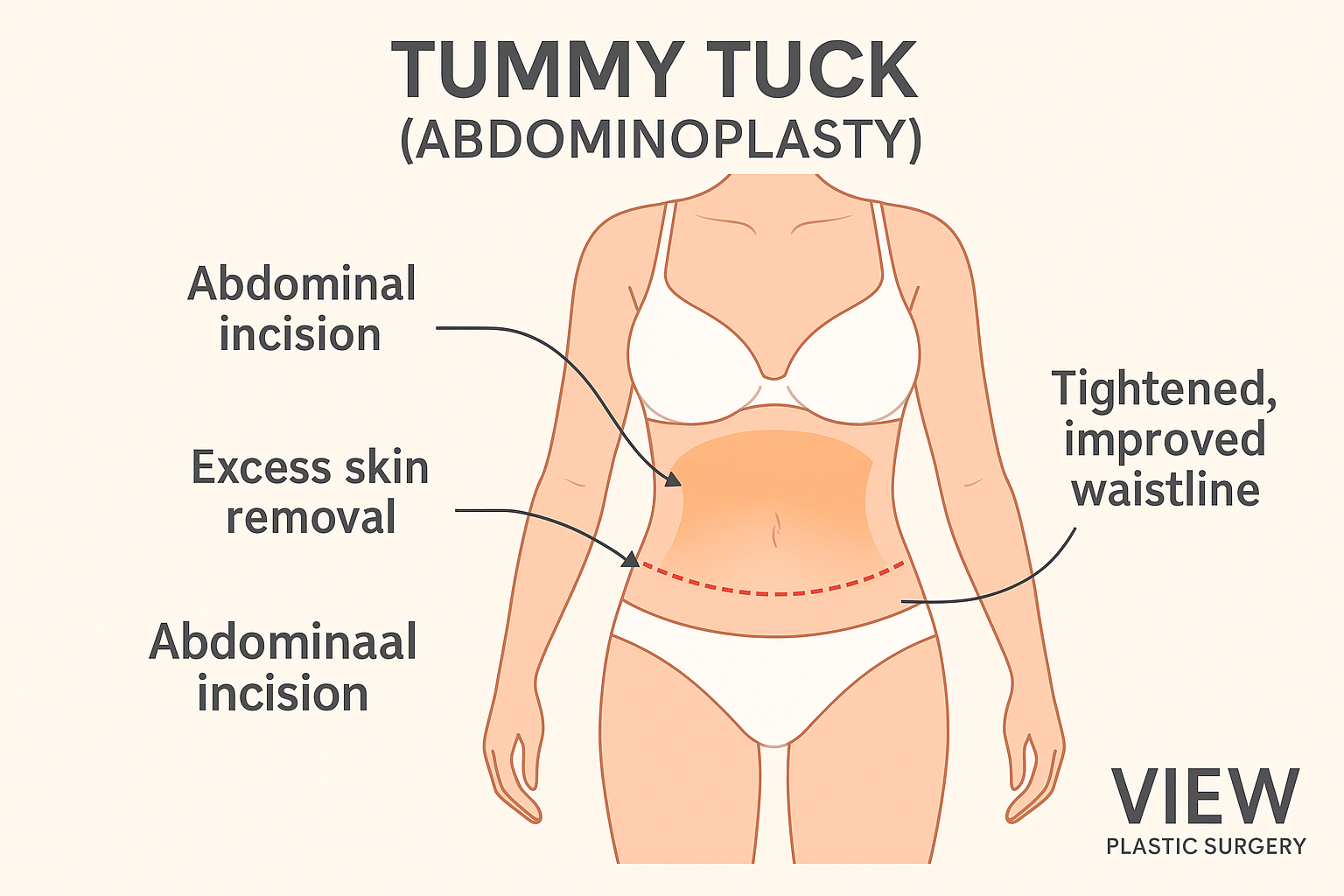
What Is a Tummy Tuck? (Abdominoplasty)
An abdominoplasty, commonly called a tummy tuck, is a reconstructive body-contouring surgery that removes excess loose skin and stubborn fat from the abdomen while repairing separated abdominal muscles when needed. It is not a weight-loss operation. Instead, it reshapes the abdominal wall and skin envelope for a flatter profile, improved waist definition, and better core support.
This procedure is frequently selected after pregnancy, major weight loss, or natural skin laxity with age when the skin’s elasticity cannot recoil. In a Korean context, the tummy tuck is often one pillar of a mommy makeover plan, and can be safely combined with targeted liposuction for flank or upper-abdomen refinement when fat pockets persist.
Abdominoplasty aims to correct three issues at once: redundant skin, excess subcutaneous fat, and midline muscle separation (diastasis). When these are treated together, patients typically see more durable changes in contour, posture, and clothing fit.
Types of Tummy Tuck Procedures
Full Abdominoplasty
The full approach addresses skin and fat above and below the navel. Surgeons remove redundant skin, tighten the rectus muscles via plication if separated, and often reposition the navel for natural aesthetics. The primary incision rests low across the pelvis to hide under underwear or swimwear. This is the workhorse technique for patients with widespread laxity and rectus diastasis.
Because the abdominal flap is mobilized more extensively, the full tummy tuck delivers the most powerful correction. Recovery is still predictable with modern protocols, and results are typically long-lasting when patients maintain stable weight.
Mini Abdominoplasty
Mini tucks target laxity below the belly button. The incision is shorter, muscle repair may be limited, and the navel is rarely repositioned. This option benefits patients with a “lower pooch” and good skin tone elsewhere. It offers a shorter operative time and faster return to work, with a more modest improvement than a full abdominoplasty.
Surgeons may combine mini tuck + liposuction for upper-abdomen or flank contouring when skin tone is good but volume persists. The combination improves circumferential harmony while keeping downtime efficient.
Belt Lipectomy (360° Lower Body Lift)
After massive weight loss, skin redundancy can extend around the entire trunk. A belt lipectomy removes circumferential excess across the abdomen, flanks, and lower back, lifting the waistline in 360°. It is more extensive than a standard tummy tuck but is often necessary to achieve uniform tightening without “dog-ear” skin bunching at the sides.
Patients must be at a stable, healthy weight and optimized nutritionally. Although scars are longer, the trade-off is global correction of draping and contour irregularities.
Fleur-de-lis Abdominoplasty
For severe laxity in both horizontal and vertical directions, the fleur-de-lis technique uses a low horizontal incision plus a vertical incision to remove central skin excess and narrow the waist. This is common after very large weight changes. The additional vertical scar enables dramatic tightening where a standard horizontal incision alone would be insufficient.
Candidacy is determined by skin redundancy patterns. When indicated, the improvement in front-view contour can be significant despite the extra scar line.
Benefits & Ideal Candidates: Who Is a Good Candidate?
Benefits. Patients report a flatter, firmer abdomen; improved waist and hourglass definition; better posture when diastasis is repaired; and relief from rashes or irritation where overhanging skin previously trapped moisture. Clothes fit more predictably, and many patients return to exercise more comfortably with a supported core.
Ideal candidates. Those with sagging or redundant abdominal skin that does not respond to diet or exercise, with or without rectus separation. Candidates should have stable weight, be non-smokers or willing to stop, have controlled medical conditions, and maintain realistic expectations. If your primary issue is fat rather than loose skin, consider targeted liposuction alone or in combination with a tuck.
Mommy makeover context. After childbearing, the skin and muscle layer may not recover baseline tension. A tummy tuck can be paired with breast procedures and selective liposuction to restore proportionality. Staging depends on safety, travel logistics, and recovery planning.
Recovery Timeline for Tummy Tuck in Korea
Protocols vary, but most international patients follow a consistent timeline. Early ambulation is encouraged to reduce clots, and compression garments support the flap and waistline.
- Hospitalization: 2 overnight stay for routine cases.
- Drain tubes: Temporary drains help prevent fluid accumulation and are usually removed at roughly 1 week based on output.
- Daily activities: Mini tuck: desk work in ~3–4 days. Full tuck: light public activity around 7–10 days; avoid heavy lifting for several weeks.
- Suture removal: Typically around 14 days post-op. Adhesive strips may remain longer to offload tension as scars mature.
Swelling continues to decline over several weeks, with scar maturation over months. Most patients wear compression 4–6 weeks and resume core exercise gradually after surgeon clearance.
Scar Management & Aftercare Services
Incisions are positioned low across the pelvis so they stay hidden under underwear or swimwear. Tension-controlled, layered closure helps scars mature into thin, flat lines. Patients should practice diligent UV protection and use silicone sheets or gels as advised. When needed, clinics may add laser, microneedling, or steroid care to optimize scar quality.
Aftercare also includes compression garment fitting, lymphatic massage where appropriate, and education on activity pacing. Long-term success relies on weight stability and healthy habits. Significant weight changes or future pregnancy can re-stretch tissues and affect outcomes.
Tummy Tuck vs. Liposuction
Both shape the abdomen but address different problems. Use this guide to decide if you are a better fit for Liposuction, a Tummy Tuck, or a strategic combination:
| Aspect | Liposuction | Tummy Tuck (Abdominoplasty) |
|---|---|---|
| Primary problem | Localized fat with good skin tone | Loose/sagging skin, stretch marks, diastasis |
| Skin removal | No | Yes |
| Muscle repair | No | Yes, if indicated |
| Navel reposition | No | Common in full tuck |
| Typical downtime | Shorter; back to desk work in a few days | 7–10 days for light public activity |
| Best as | Standalone when skin is tight | Standalone for lax skin or combined with lipo |
Fit summary: If you mainly have fat, start with liposuction. If you have loose skin or muscle separation, a tummy tuck is the definitive solution. Many patients choose a combo for 360° refinement, especially in a mommy makeover plan.
Frequently Asked Questions (Q&A)
Should I combine a tummy tuck with liposuction?
How long should I plan to stay in Korea for tummy tuck surgery?
How long do I have to wear the compression garment?
Why are drainage tubes (drains) used after a tummy tuck?
Can I have a tummy tuck if I plan to get pregnant in the future?
Does a tummy tuck remove stretch marks?
When can I exercise again?
How noticeable are the scars long term?
Is a tummy tuck part of a mommy makeover?
What if my main issue is fat, not loose skin?
You may be better served by liposuction alone. If skin laxity is mild, combination liposuction + mini tuck can be efficient with faster recovery.
Related Keywords
tummy tuck Korea, abdominoplasty Seoul, mini tummy tuck Korea, full abdominoplasty Korea, belt lipectomy 360 Korea, fleur-de-lis abdominoplasty Korea, mommy makeover Korea, liposuction vs tummy tuck, tummy tuck recovery Korea