



What Is Ptosis Correction?
Ptosis correction is particularly effective when eye-opening power is insufficient. The following cases typically show the greatest improvement.
Eye Types That Need Ptosis Correction
Ptosis correction addresses structural weakness in eyelid-opening power. When the levator muscle does not function properly, the eyes appear dull, tired, or partially covered regardless of eyelid crease height. By strengthening or adjusting the lifting mechanism, the eyes open more clearly and naturally.
When the upper iris is poorly exposed
If only 1–2 mm of the upper iris is visible—or if the pupil is partially covered—this indicates mild to moderate ptosis. These eyes tend to look sleepy, tired, and unfocused, and the crease height alone cannot improve clarity. Correcting the opening power restores proper iris exposure and significantly improves visual clarity and expressiveness.
When the forehead and eyebrows are used to open the eyes
Using the forehead to lift the eyelids is a typical compensatory habit that occurs when levator strength is weak. Common signs include.
- Deep forehead wrinkles in frontal photos
- Constantly raised eyebrows, creating a tense facial expression
- Premature aging caused by habitual forehead activation
After ptosis correction, the eyes open naturally without forehead effort, resulting in a more relaxed and balanced expression.
When the eyelid crease exists but the eyes still look dull
Some people have a visible crease, but the eyes still appear unfocused. This is not a line design issue—it is a functional issue caused by insufficient levator power. In these cases, repeated double-eyelid revisions do not produce meaningful improvement and may even lead to an unnaturally high crease. When ptosis correction is added.
- The crease stabilizes naturally
- Eye focus becomes clearer
- Makeup visibility improves dramatically
This is a structural problem that requires functional correction, not cosmetic redesign.
Heavy eyelids with excess fat and weak eyelid-opening power
Thick skin or heavy fat pads weigh down the eyelids, further reducing levator strength. Typical signs:
- Crease does not hold well
- Eyes look more tired as the day goes on
- Eye definition fades even with makeup
For these cases, the most effective combination is: Incisional Method + Ptosis Correction + Fat Repositioning, which provides the most stable and long-lasting improvement.
Asymmetry caused by unequal eyelid-opening strength
When one eye appears noticeably larger or more open in photos, the cause is often levator strength imbalance, not crease asymmetry. Ptosis correction allows adjustment of each side’s opening power, producing:
- Better symmetry
- More stable crease formation
- Natural alignment of eyelid angles
Benefits of Ptosis Correction
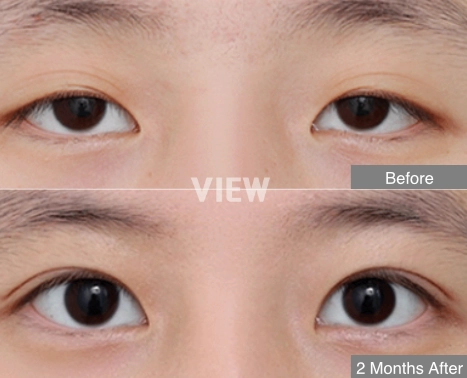
The core benefit is increased opening power, which enhances both eyelid function and facial expression.
Improved eyelid-opening power
By strengthening or repositioning the levator muscle, the eyelids lift more effectively. Key improvements include:
- Increased iris exposure → clearer, more focused eyes
- Reduction of a tired or sleepy appearance, leading to a brighter overall impression
- Natural eyelid opening without forehead compensation, resulting in a more stable facial expression
This improvement is often the most immediately noticeable change after surgery.
Enhanced facial definition
Because the eyes are the focal point of the face, improved opening power can make the entire expression look more organized and balanced.
- Eyes open fully without forehead tension → expression softens
- Tired appearance fades → overall impression becomes brighter and more energetic
Ptosis correction does not only change eye size; it reshapes expression, atmosphere, and first impressions.
Improved crease stability
When eyelid-opening power is weak, high creases collapse or loosen easily. After ptosis correction:
- The crease maintains its position more reliably
- Stability increases, especially when combined with incisional or partial-incisional methods
- Fat-heavy eyelids achieve longer-lasting crease formation
Thus, ptosis correction enhances both the aesthetics and durability of double-eyelid surgery.
Correction of asymmetry
If asymmetry originates from muscle strength differences:
- Ptosis correction balances levator function on both sides
- Eye size, crease height, and eyelid angles become more symmetrical
- Preexisting irregularities in the crease often improve as well
Therefore, when asymmetry originates from differences in levator muscle strength, ptosis correction becomes the most direct and effective solution.
Ptosis Self-Check Guide
While a professional examination is ideal, basic signs of ptosis can be self-evaluated. Weak levator function causes inadequate iris exposure and a tired appearance, which is often mistaken for a crease issue but is actually a functional problem.
You can assess yourself using the following:
- Check the iris exposure in a relaxed state
If more than 2 mm of the upper iris is visible → normal.
If 1 mm or less is visible → possible ptosis. - Open your eyes without using your forehead
If the eyes do not open well without forehead effort → muscle weakness is likely. - Compare left and right eyes in frontal photos
Size or angle differences may indicate levator asymmetry. - Lift the eyelid slightly with a finger
If your field of vision instantly widens → the levator muscle is underperforming.
Who Benefits Most from Ptosis Correction?
The following cases typically experience the most dramatic improvement:
- Eyes look more closed or dull after double-eyelid surgery
- Persistent sleepy or tired appearance
- Forehead-dependent eye opening
- Clear crease but insufficient sharpness
- Poor iris exposure (1–2 mm or less)
- Asymmetry caused by unequal eyelid-opening power
- Revision cases with unstable or weak crease retention
These patients often see significant enhancement in clarity, balance, and long-term crease stability.
Cases That Do Not Require Ptosis Correction
Ptosis correction is not necessary when levator function is already sufficient. In such cases, additional correction may result in overcorrection and unnatural appearance. If the issue is unrelated to muscle function, other procedures are more appropriate—such as adjusting the crease, removing excess fat, or addressing skin laxity.
Common cases where ptosis correction is unnecessary:
- Adequate iris exposure and strong eyelid-opening power
- No forehead involvement during eye opening
- Desire to change only the crease style (In-line, Semi-Out, Out-line)
- Tired appearance caused solely by fatty eyelids or skin sagging, not by levator weakness
(upper blepharoplasty or fat removal may be more suitable)
FAQ
Does ptosis correction always make the eyes bigger?
The goal is not size, but clarity, iris exposure, and lifting strength.
Can the eyes look sharper without raising the crease height?
Yes. Improved opening power often enhances definition without creating a higher crease.
Can mild ptosis be fixed with non-incisional double-eyelid surgery alone?
Usually not. Without functional correction, crease retention is weak and loosening is common.
Is overcorrection a concern?
Modern techniques use fine-tuned adjustment methods, making overcorrection uncommon.
Is ptosis correction necessary during revision surgery?
If crease instability or asymmetric opening power exists, ptosis correction is often required.
Will the eyes look too intense after correction?
No. Design and correction strength can be tailored for a natural, soft appearance.
Travel & Recovery Schedule for Overseas Patients
Overseas patients are generally advised to stay at least 7 days in Korea.
This allows
- Swelling to subside
- Stitches removal (Day 5–7)
- Initial recovery assessment
Minimum Stay
7 days is ideal for complete early recovery.
- Surgery
- 48-hour cold compression
- Post-op check
- Stitch removal
- Initial swelling reduction
Leaving earlier than this is not recommended.
Pre-Surgery Precautions
- Stop contact lens use
- No alcohol or smoking 48 hours prior
- Stop blood-thinning supplements
- No heavy eye makeup
- Remove eyelash extensions before surgery
Post-Surgery Care
0–48 Hours
- Cold compress
- Sleep with head elevated
- No rubbing
- No water contact
Day 2–7
- Light cleansing allowed
- Avoid soaking eyes
- No makeup until stitch removal
- Natural reduction of swelling & bruising
Stitch Removal
- Mild swelling/bruising is normal
- Temporary swelling may increase during flight
- Warm compress before flight
- Hydration is essential
Return Flight Timing
Most patients return home after Day 7.
- Mild swelling and bruising are normal.
- Temporary swelling may increase during flight.
- Warm compress before flight.
- Hydration is essential.
By 2–4 weeks, the appearance typically looks natural in daily life.