


What is Hair Transplant?
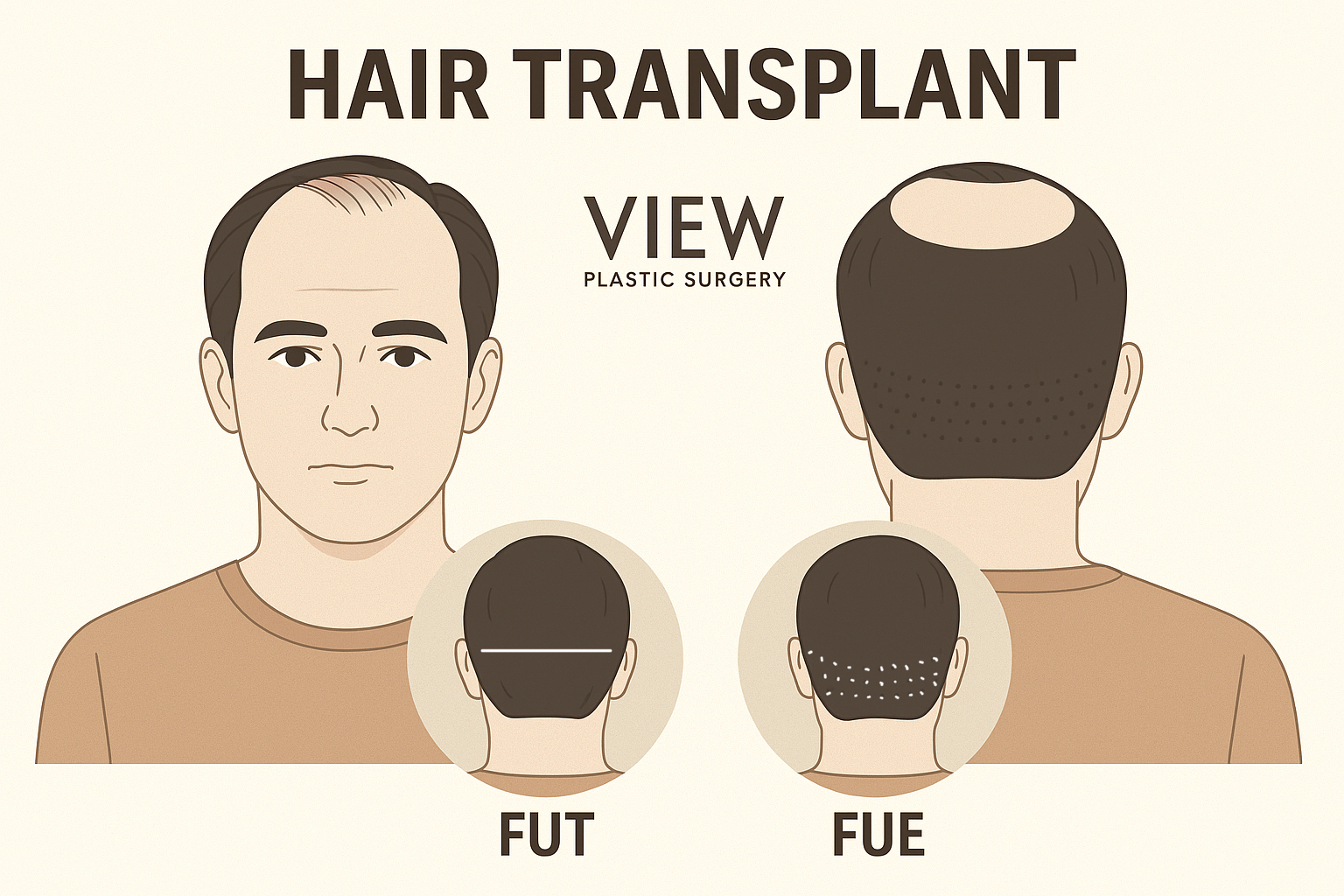
A hair transplant moves healthy follicles from the donor area at the back of the scalp to thinning or bald zones such as the hairline, mid-scalp, and crown. The two primary harvesting methods are FUT (strip/FUSS) and FUE (punch-by-punch). The choice depends on donor density, graft count targets, hairstyle, and scar preferences. For an overview of our program and outcomes, visit the Hair Transplant main page.
FUT (Follicular Unit Transplant / Strip) removes a narrow strip from the donor zone, then closes the area with sutures. Advantages include no full buzz cut, faster harvesting, and suitability for lower donor density. Trade-offs include a linear scar and suture removal around day 14. FUE (Follicular Unit Extraction) harvests follicles individually using a micro-punch. Benefits include no linear scar, quicker recovery, and less post-op discomfort; trade-offs include a wider shaved donor field, longer harvest time, and dot-like hypopigmented marks when hair is worn very short.
When FUT vs. FUE is Chosen
- Lower donor density or very high graft goals (>3,000): FUT is often preferred to avoid over-thinning the donor area and to keep operative time efficient.
- Female patients who keep long hair: FUT helps avoid broad shaving.
- FUE shave styles: full shave, linear shave, or no-shave “hidden cut,” chosen based on work/social constraints.
Causes of Hair Loss (Male & Female)
Most pattern hair loss is driven by DHT-mediated miniaturization, where thick hair gradually thins over time. Medical therapy can slow the rate of loss but cannot restore areas that are fully bald; transplantation addresses those zones.
Male pattern commonly starts at the temples (M-shape), the crown (O-shape), or progresses to a U-pattern. Female pattern often shows central part widening and frontal hairline elevation, with variable diffuse thinning.
Who Is Hair Transplant Recommended For?
- Adults with stable health who have permanent donor hair at the occipital area.
- Men or women with established recession or crown thinning not responsive to medical therapy.
- Those seeking permanent hairline framing, crown density, or sideburn/beard reconstruction.
- Patients aligned with realistic density expectations: transplanted zones may appear less dense than native hair until maturation at ~12 months.
Hair Transplant Surgery Process
We standardize pre-op, intra-op, and aftercare to maximize graft survival and convenience for international patients.
Pre-operative
- Anesthesia plan: general anesthesia is used in our protocol.
- Fasting: 8 hours nil per os prior to surgery.
- Hair prep: for patients with gray/white hair, dark dye the day before to aid follicle visualization.
Graft Design
Design maps target zones and angles so transplanted hairs align with native growth to avoid an artificial look. This is a core differentiator of Korean technique during the implantation stage.
Extraction
FUT: mark a 2–2.8 cm-tall strip in the donor safe zone, trim, excise, and close primarily; sutures are removed around day 14.
FUE: harvests are spread across a wider field to avoid visible thinning; donor is usually shaved per full/linear/no-shave plan.
Implantation
Separated follicular units are placed respecting hair direction transitions (e.g., 10–20° frontal to 35–45° vertex) for natural flow, using a multi-member team: surgeon, lead nurse, IV nurse, and follicle-separation nurse(s).
Aftercare
Immediate hemostasis is applied to the donor area. Patients lie supine to maintain pressure and control bleeding, then begin staged shampoo and graft-care protocols from day 1.
Post Hair Transplant Recovery Guide
Timeline: FUT vs. FUE
- FUT: dressing and donor care day 0–1; gentle shampoo begins day 1; suture removal around day 14.
- FUE: no sutures; faster donor recovery; typical check around day 7.
Graft-site care
- Day 0: apply graft-support spray once. Days 1–3: continue frequent spray applications. From day 4: use water mist to relieve itch as scabs form. Return to normal shampooing after day 14.
- Shampoo rules: room-temperature water, low pressure; foam shampoo in hands and pat on grafts without rubbing; rinse gently. Dry with cool, low-pressure air over grafts; donor can tolerate warmer, stronger airflow.
Frequently Asked Questions (Q&A)
Is Hair Transplant Surgery painful?
Is Hair Transplant only for men?
Will the transplanted hair grow permanently?
I’m a foreign patient — can I choose the color of the transplanted hair?
Related Keywords
hair transplant Korea, FUT vs FUE Korea, no-shave FUE Korea, Korean hair transplant clinic, hairline lowering Seoul, crown transplant Korea, graft survival tips, hair transplant recovery Korea, View Plastic Surgery hair transplant