


Introduction
Facial contouring surgery refines the bony framework of the face—cheekbones, jawline, and chin—to achieve smaller, more balanced proportions. Learn the surgical options on our Facial Contour main page and specific procedures such as Zygoma Reduction, Square Jaw Reduction, and Genioplasty (or Chin Implant).
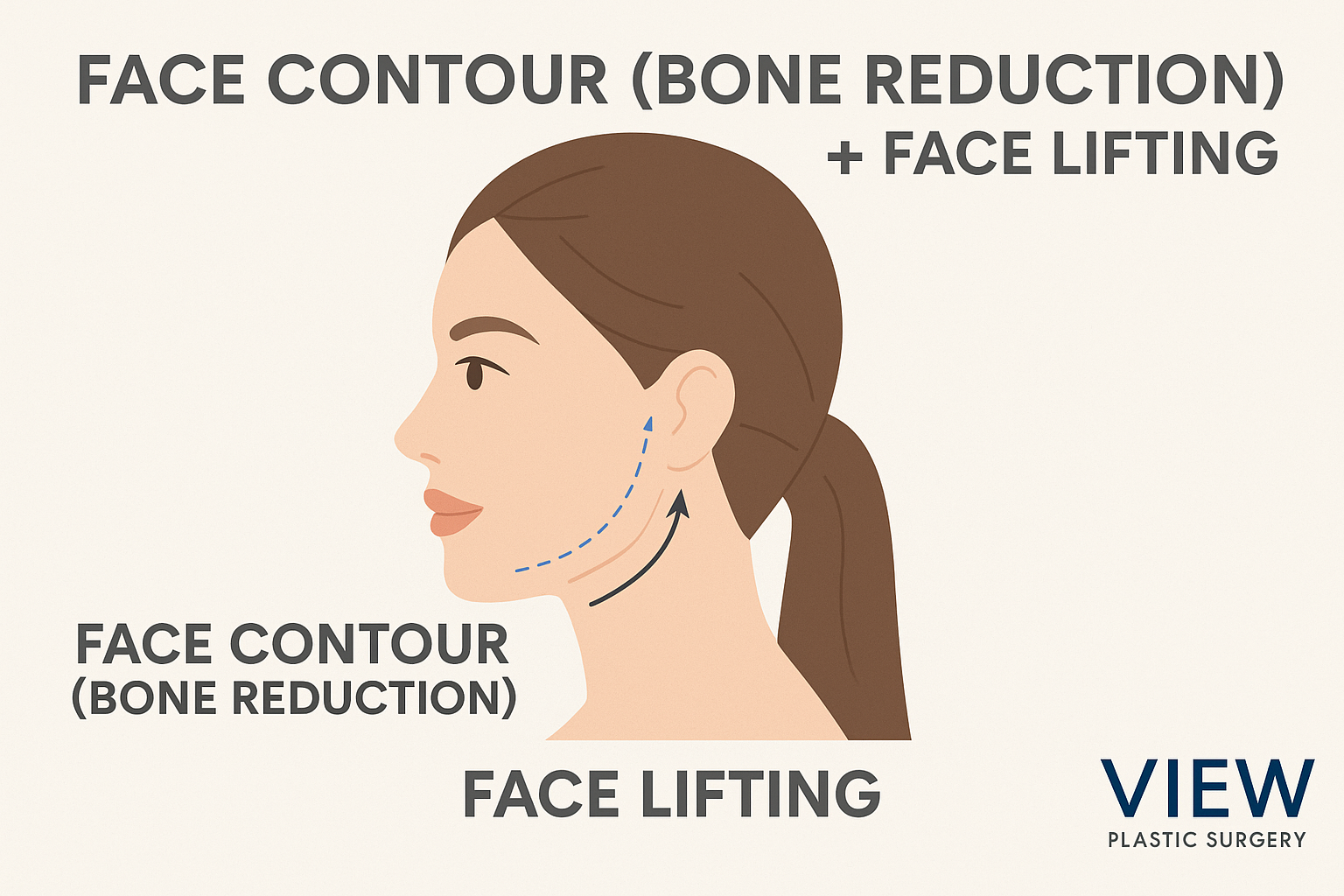
A common post-operative concern is soft-tissue sagging. When bone projection is reduced, the same amount of skin and soft tissue may sit more loosely, especially along the jowls and jawline. To prevent this, many patients plan a Face/Neck Lift or, at minimum, a Thread Lift at the same time. This combined strategy supports tissues on the day the bony foundation changes, helping preserve a sharp contour long term.
Our surgical lift pages: Facelift, Mini Lift, and minimally invasive options Thread Lift or our protocol 3EA Face Fit.
Why Sagging Happens After Facial Contouring Surgery
Contour reduction decreases skeletal “scaffolding.” When the cheekbone or mandibular angle is reduced, overlying soft tissue—skin, fat, and SMAS—loses some support. Gravity then accentuates laxity at the pre-jowl sulcus, marionette lines, and submandibular area. The result can be new or worsened jowling if soft tissues are not tightened.
Age, skin elasticity, and existing laxity compound the effect. Patients 30+ with early laxity or thinner skin are more prone to visible descent after bone reduction. Proactive lifting at the time of contouring counters this biomechanical shift, keeping the “skin envelope” matched to the new bone shape.
Benefits of the Combined Surgery (Facial Contouring + Facelift)
- Prevents jowling early: Tightens skin/SMAS as the bone is reduced, keeping jawline definition.
- Single recovery arc: Most stitches removed at ~14 days, with one travel itinerary for international patients.
- Balanced proportions: Bone, soft tissue, and skin are harmonized in a single plan for stable long-term results.
- Customization: Choice of full lift, mini lift, or thread lift by severity and patient age/skin quality.
Who Should Consider a Combined Procedure
Candidates for Combined Facial Contouring + Facelift
Best candidates are those planning contour reduction who already notice early laxity, jowls, or neck banding; those seeking a very sharp jawline; or anyone who has undergone significant weight changes affecting facial soft tissue. Patients wanting to avoid a staged second trip often choose the combined approach for efficiency and predictability.
Age Guidance
We generally recommend assessing a lift for patients age 30 and above, especially when cheekbone or jaw angle reduction is significant. Younger patients with excellent elasticity may opt for a Thread Lift adjunct, while patients 40+ with skin redundancy benefit from a Mini Lift or Full Facelift for decisive tightening.
Choosing the Right Type of Facelift in Korea
Full Facelift
Addresses moderate-to-severe laxity of the midface, jawline, and neck. SMAS/platysma release and deep fixation allow strong, durable correction. Ideal to pair with larger reductions such as zygoma + jaw + genioplasty (see the 3-area option here).
Mini-Facelift / Mid-Face Lift
Uses shorter incisions and limited SMAS work to sharpen early jowls with less downtime. A good match for smaller reductions or younger patients. Learn more on our Mini Lift page.
Thread Lift
Minimally invasive threads reposition tissue vectors and stimulate collagen. Works well for mild laxity or as an adjunct to facial contouring when patients prefer minimal incisions. Details on our Thread Lift and 3EA Face Fit pages.
Non-Surgical Options (Ultherapy)
Ultrasound-based collagen tightening can maintain results but should be performed ≥ 6 months after facial contouring to allow bony and soft-tissue remodeling. It is supportive, not a replacement for surgical tightening when bone reduction is substantial.
Quick Selector: Which Lift Matches Your Contouring Plan?
| Scenario | Recommended Lift | Why |
|---|---|---|
| 3-area facial contouring (zygoma + jaw + genioplasty) | Full Facelift/Neck Lift | Maximal tissue support and skin excision to prevent jowling after major bone reduction |
| Lower-face focus (jaw + genioplasty / V-line) | Mini Lift | Shorter downtime, targeted jowl control |
| Small reduction, excellent elasticity, age < 40 | Thread Lift | Minimally invasive support the same day as contouring |
Recovery Timeline Comparison
| Path | Typical Downtime | Stitch Removal | Notes |
|---|---|---|---|
| Facial Contouring only | 7–14 days social downtime | Varies by osteotomy; facial stitches usually ≤ 7–10 days | Risk of new jowling if pre-existing laxity is present |
| Facelift only (with neck lift as indicated) | 10–14 days for public-facing recovery | ~14 days | Addresses jowls/neck bands; no bone change |
| Combined (Facial Contouring + Facelift) | 10–14 days for most patients | ~14 days (single removal visit) | Single trip, synchronized healing, stronger jawline definition |
For patients choosing a Thread Lift adjunct instead of surgical lift, there is usually no stitch removal or removal at around 3 days for tiny entry sites.
Frequently Asked Questions (Q&A)
Can I combine both procedures together?
Can I get a facelift immediately after facial contouring?
Will combining surgeries increase recovery time?
Can non-surgical procedures like Ultherapy prevent this sagging?
Will the facelift incision be visible if I have both procedures done?
Is it safe to perform both facial contouring and facelift together?
Will combining surgeries increase swelling or bruising?
Can nerve damage occur when both surgeries are done together?
How can I maintain my results long-term after the combined surgery?
Can men also undergo combined facial contouring and facelift procedures?
Related Keywords
facial contouring facelift Korea, prevent sagging after facial contouring, thread lift with facial contouring, mini lift after jaw reduction, facelift and V-line surgery Korea, zygoma reduction facelift, combined face neck lift Korea, Ultherapy after facial contouring