


When considering facial enhancement, the nose plays a pivotal role as the center of the face. However, the pursuit of beauty is not merely about achieving a higher bridge or a sharper tip; it is about balance, proportion, and harmony. At View Plastic Surgery, we believe that the “best” nose is not a template but a tailored design that respects your unique facial architecture. This comprehensive guide will walk you through the nuances of finding the perfect nose shape for your face and what to expect during a professional rhinoplasty consultation in Seoul.
Rhinoplasty Consultation Seoul: Why It Is Crucial
In the world of aesthetic surgery, trends come and go. From the “Dolly” nose of the early 2000s to the current preference for “Natural Chic,” popular styles shift. However, a nose that looks perfect on a celebrity may look out of place on your face. This is why a detailed consultation is the most critical step in your journey. It is estimated that 90% of a surgery’s success is determined before the scalpel is ever lifted—during the planning phase.
A professional consultation goes beyond simple aesthetics. It involves a medical analysis of your breathing function, skin thickness, cartilage strength, and previous surgical history. When seeking a rhinoplasty consultation in Seoul, you are accessing some of the world’s most advanced diagnostic technologies, such as 3D CT scanning, which allows surgeons to visualize the internal structure of the nose and predict surgical outcomes with high precision.
The Shift from Trend to Harmony
Modern rhinoplasty focuses on “Facial Harmony.” This concept posits that the nose should lead the viewer’s eye to the eyes, not distract from them. If a nose is too small for a wide face, the face looks larger. If a nose is too high for a flat forehead, the profile looks convex. Understanding these relationships is the core of our consultation process.
The Golden Ratio: Defining the Ideal Nose
While beauty is subjective, aesthetic medicine relies on the “Golden Ratio” (1:1.618) and specific facial angles to create a result that is universally pleasing. During your consultation, we analyze several key metrics:
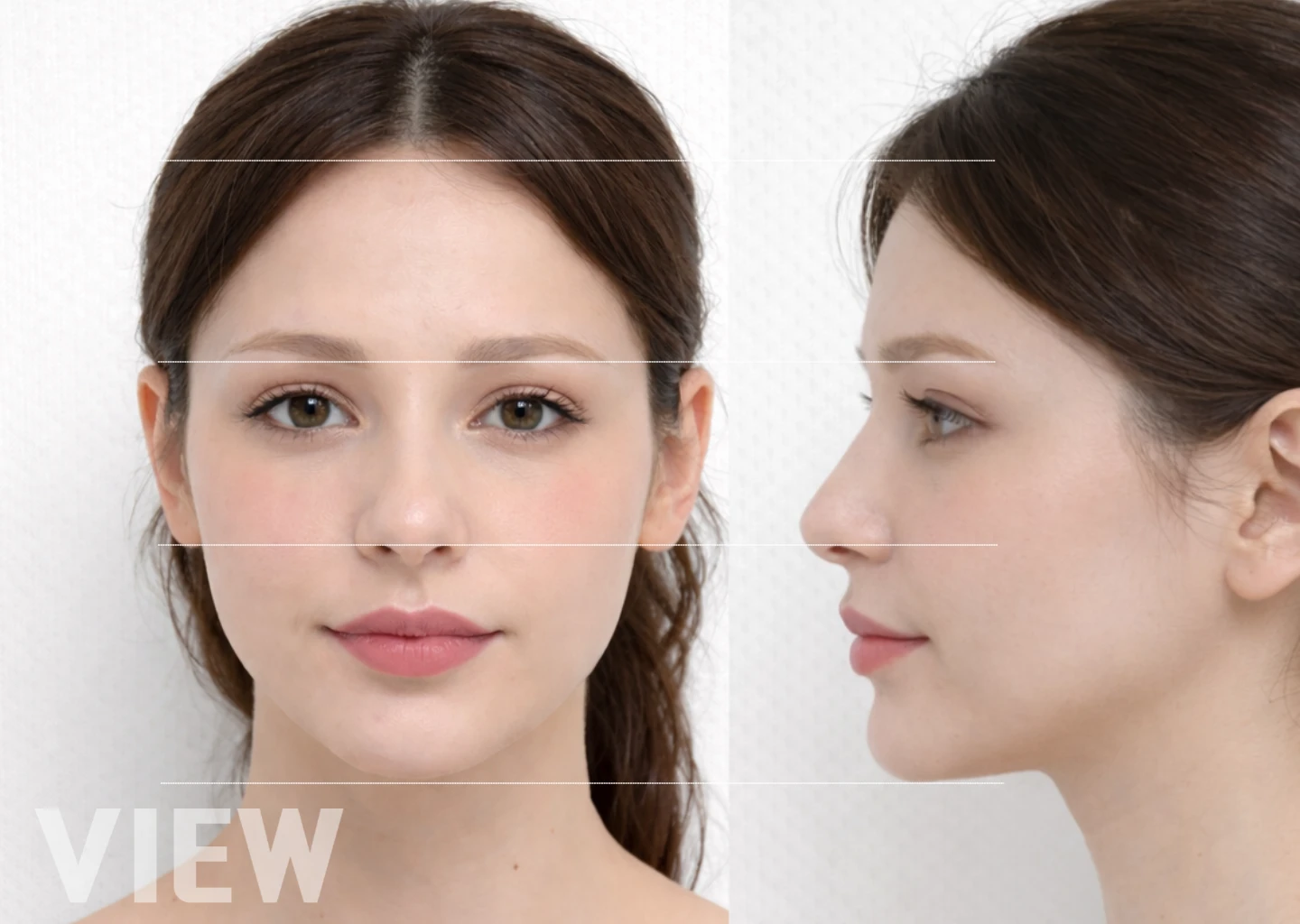
Vertical Facial Thirds
Ideally, the face is divided into three equal horizontal sections:
- Upper Third: Hairline to Glabella (between eyebrows).
- Middle Third: Glabella to Subnasale (base of the nose).
- Lower Third: Subnasale to Menton (chin).
A harmonized nose should occupy exactly one-third of the face’s vertical height. If the middle third is short, lengthening the nose can balance the face. Conversely, if the middle third is long, specific techniques are used to visually shorten the nose.
The Nasofrontal and Nasolabial Angles
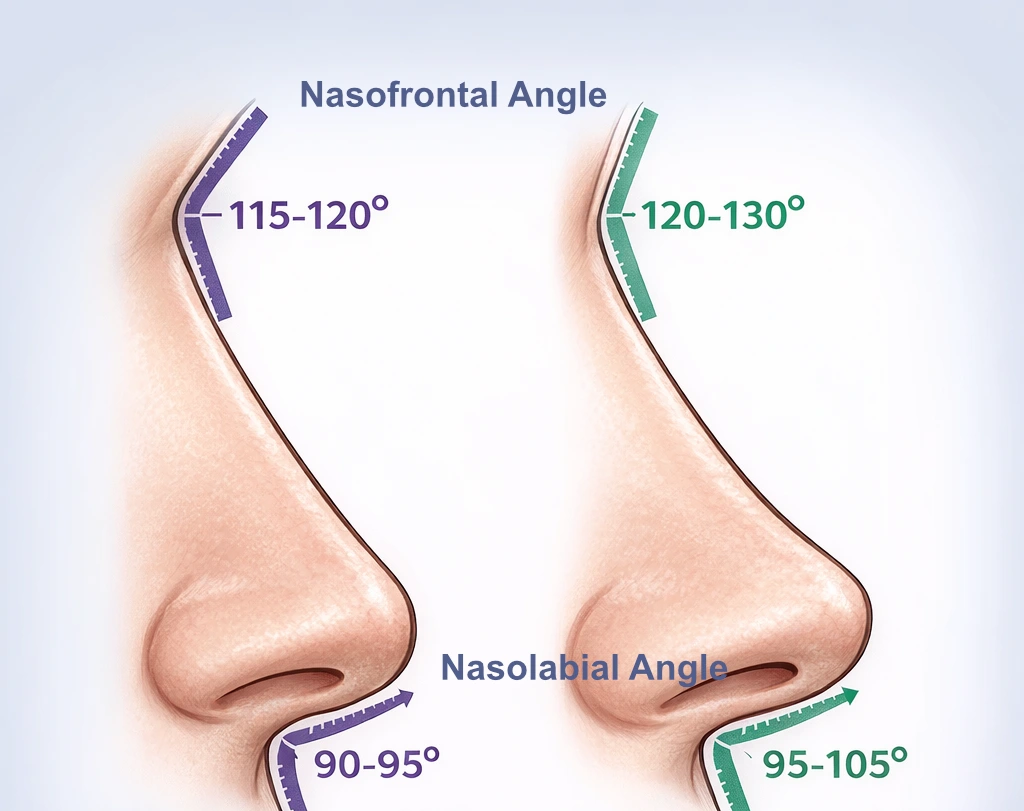
The Nasofrontal Angle: Defining the Bridge Start
The Nasofrontal Angle is the transition point where your forehead ends and your nasal bridge begins (the radix).
- The Ideal Range: For a natural look, this angle should typically fall between 115° and 130°.
- Clinical Significance: If the angle is too wide (above 135°), it creates a “Greek profile” where the nose appears to start directly from the forehead, often looking flat or heavy. Conversely, an angle that is too deep or sharp can make the nose look unnaturally detached and the facial features appear overly severe.
- Customization in Seoul: During your consultation, we use 3D CT imaging to determine the exact position of your radix, ensuring the bridge starts at the level of your upper eyelid lash line for a seamless, elegant flow.
The Nasolabial Angle: The Key to Tip Projection and Gender Aesthetics
The Nasolabial Angle—the angle between the columella (base of the nose) and the philtrum (upper lip)—is the primary factor in determining how “upturned” or “straight” the nose appears.
- For Women (95° to 105°): A slightly wider angle is preferred to create a soft, feminine, and youthful “semi-curved” look. This subtle upturn provides a refreshed and elegant appearance.
- For Men (90° to 95°): Men generally require a sharper, more perpendicular angle. A straight projection is essential to maintain a strong, masculine profile without making the nose look “pig-like” or overly rotated.
- The Impact of Protruding Mouth: In many Asian patients, a protruding mouth can make this angle look smaller (acute). Our surgeons often perform columella strut grafting to support this angle, which not only improves the nose shape but also visually improves the appearance of a protruding mouth.
Finding the Nose Shape for Your Face Type
Your skeletal structure dictates which nose shape will look most natural. Here is a breakdown of common face shapes and the recommended rhinoplasty strategies.
| Face Shape | Characteristics | Recommended Nose Shape | Surgical Goal |
|---|---|---|---|
| Round Face | Soft edges, width equals length, fuller cheeks. | High Bridge, Refined Tip | Adding height and defining the tip creates a vertical line that visually slims the face. Avoid a short, button nose which can make the face look rounder. |
| Long / Oval Face | Elongated structure, often with a high forehead or long chin. | Straight or “Barbie Line” | Avoid over-lengthening. A straight profile or a very slight curve helps break up the length of the face. The tip should not be too droopy. |
| Square / Angled Face | Strong jawline, broad forehead. | Soft Curve (Semi-Curved) | A nose with a softer, slightly curved silhouette balances the strong angles of the jaw. A sharp, pointy nose can make the face look too aggressive. |
| Heart-Shaped Face | Wide forehead, narrowing to a pointed chin. | Proportional, Natural | This face shape is versatile. The focus is usually on refining the bridge width to ensure it doesn’t dominate the delicate chin area. |
Case Study: Balancing the Nasofrontal and Nasolabial Angles
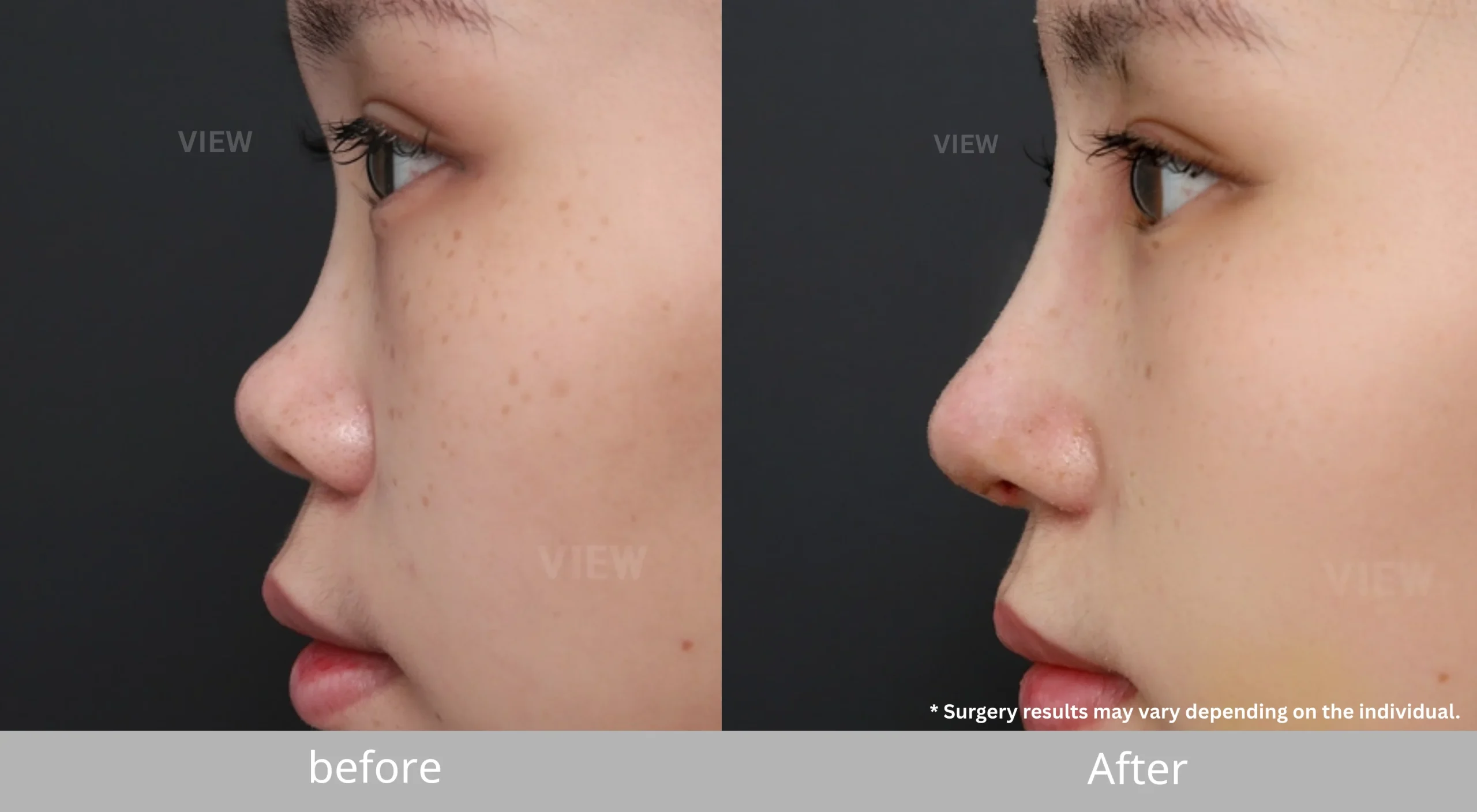
The before-and-after profile of this patient perfectly illustrates how subtle adjustments to facial angles can transform the entire facial impression.
- Refining the Nasofrontal Transition: In the “Before” photo, the starting point of the bridge (the radix) was relatively low, making the forehead appear slightly more prominent. After the procedure, the bridge starts smoothly from the eyelid level, achieving the ideal 115°–130° Nasofrontal angle.
- Correcting the Nasolabial Angle: The patient initially presented with a slightly acute nasolabial angle, which can sometimes make the mouth look more protruded. By refining the tip projection and adjusting the angle to approximately 95°–105°, we achieved a soft, feminine “semi-curved” line that complements her jawline.
- Structural Definition: You can observe how the bridge height was raised to add verticality to the face, which is a key strategy for enhancing facial harmony in patients with softer facial edges.
Ethnic Rhinoplasty: Customization is Key
One of the reasons international patients flock to View Plastic Surgery is our expertise in ethnic rhinoplasty. The anatomy of the nose varies significantly across different ethnicities, and a “one-size-fits-all” approach is disastrous.
Asian Rhinoplasty
Typically characterized by thicker skin, weaker cartilage, and a lower nasal bridge. The goal is often projection and definition. We utilize autologous materials like septal cartilage or rib cartilage to build structure without the risk of extrusion associated with large implants. Learn more about our safety protocols in our Safe Surgery System.
Caucasian Rhinoplasty
Often involves reduction rhinoplasty—removing a dorsal hump, de-projecting the tip, or refining a wide nasal bone (osteotomy). Preservation of breathing function is paramount here, as reducing the nasal airway too much can lead to functional issues.
African / Hispanic Rhinoplasty
Curious about how nasal anatomy varies across different backgrounds? You can find a detailed breakdown in our previous guide, [Ethnic Rhinoplasty in Korea: Customized Surgical Approaches].
The Essential Rhinoplasty Consultation Questions Checklist
To maximize the value of your consultation, preparation is essential. Many patients forget to ask critical questions due to nervousness. We have compiled a list of rhinoplasty consultation questions you should bring with you. You can even book a consultation with us to ask these directly.
| Category | Questions to Ask | Why This Matters |
|---|---|---|
| Surgical Technique & Materials | Will you use silicone, Gore-Tex, or my own cartilage (ear, septum, rib)? Open vs. Closed approach? |
Autologous materials (your own body tissue) generally have lower infection rates. Open rhinoplasty offers better visibility for complex reconstruction. |
| Safety & Anesthesia | Is there a dedicated anesthesiologist on site? What happens in an emergency? |
Ensures the clinic prioritizes patient safety over profit. View Plastic Surgery has resident anesthesiologists 24/7. |
| Recovery & Aftercare | What is the swelling timeline? Does the clinic provide deswelling treatments? |
Understanding the downtime helps you plan your trip. Learn about our comprehensive aftercare system here. |
Is a Rhinoplasty Consultation Free?
A common search query is “rhinoplasty consultation free.” In Korea, policies vary. Some clinics charge a diagnostic fee, especially if CT scans are involved, while others waive this if surgery is booked. At View Plastic Surgery, we offer various consultation packages for international patients. It is best to contact us directly to understand the current promotions and consultation structures available for your region.
Start Your Journey with View Plastic Surgery
Your face deserves the expertise of a world-class team. Whether you need a subtle refinement or a complex reconstruction, View Plastic Surgery combines artistic sensibility with medical rigor. Don’t leave your appearance to chance.
Ready to find your best nose shape? Click here to chat with us on WhatsApp for a quick assessment or to schedule your in-depth consultation.