



When discussing Rhinoplasty in Korea, the immediate assumption is often a complete structural overhaul—silicone implants, tip plasty, and osteotomy. However, a significant trend has emerged among international patients visiting View Plastic Surgery: the preference for Alar Reduction as a standalone procedure. For many, the issue isn’t the height of the bridge but the width of the nostrils, which can dominate facial proportions.
This deep-dive analysis explores why refining the nostril wings (alar base) is often the “missing link” to achieving a sophisticated facial profile without the downtime of a full nose job.
What Is Alar Reduction? (Understanding the Anatomy)
Alar Reduction, clinically known as alarplasty, is a specialized surgical intervention designed to narrow the width of the nose by reshaping the alar base (the fleshy wings of the nostrils). Unlike comprehensive rhinoplasty, which addresses the nasal bone and cartilage framework to alter height or projection, alar reduction focuses strictly on the horizontal dimensions of the nose.
The procedure targets the nasal flare (the convexity of the alar lobule) and the nostril sill (the floor of the nostril). By excising a calibrated wedge of tissue or using cinching sutures, surgeons can alter how the nose anchors to the cheeks.
- It does not change the profile height: The bridge remains untouched.
- It alters the ‘Facial Triangle’: Narrowing the base changes the visual triangulation of the face, often making the mid-face appear more compact.
- High-Impact, Low-Trauma: It is one of the few cosmetic surgeries where a minor tissue adjustment yields a massive shift in first impressions.
For patients satisfied with their side profile but unhappy with their frontal view, this procedure is often the definitive solution. If you are unsure if this applies to you, we recommend a personal consultation to assess your nasal structure.
Why Alar Reduction Alone Can Dramatically Change Your Appearance

Why does a millimeter of reduction at the nostrils look like a centimeter of change in photographs? The answer lies in facial geometry and optical illusions.
The Relative Height Illusion
The human eye perceives the height of the nose relative to its width. A wide alar base creates a visual anchor that flattens the appearance of the nose, even if the bridge is actually of average height. By narrowing the base, the existing bridge appears higher and more defined by contrast, without physically adding any implants.
The Rule of Fifths
In ideal facial proportions, the width of the nose should roughly equal the distance between the inner corners of the eyes (intercanthal distance). When the alar base extends beyond these vertical lines, the nose dominates the central third of the face. Correcting this restores balance, drawing attention back to the eyes.
The "Smiling" Problem
Many patients complain that their nose looks acceptable when resting but spreads excessively when smiling. This dynamic flaring is caused by the pull of facial muscles on the alar base. Alar Reduction surgery creates a firmer anchor point, reducing the extent of this spread during facial expression.
Who Is Satisfied with Alar Reduction Without Nose Bridge Surgery?

Not everyone requires a full nose job. At View Plastic Surgery, we often dissuade patients from unnecessary bridge augmentation if their primary concern is width. You are an ideal candidate for standalone Alar Reduction if:
- You have a “Royal” Bridge: Your nasal bridge has sufficient height and a straight dorsal line, but the tip or base looks bulbous or wide.
- Frontal View Anxiety: You like your side profile (selfies from the side look good), but you dislike straight-on photos because the nose looks flat or wide.
- Dynamic Flaring: Your nostrils flare significantly when you laugh or speak.
- Time Constraints: You are visiting Korea for a short trip and cannot commit to the 2-week downtime associated with osteotomy or implants.
For a comprehensive look at all nasal procedures we offer, visit our Rhinoplasty Center page.
Alar Reduction Techniques: Incisional vs. Non-Incisional
The choice of technique is critical and depends on the thickness of the skin and the degree of flaring. We categorize these into two primary approaches.
| Feature | Incisional Method (Wedge Excision) | Non-Incisional / Minimal Incision |
|---|---|---|
| Procedure | Removing a wedge of tissue from the alar groove (external) or sill (internal). | Using medical-grade threads to cinch the alar base together internally. |
| Best For | Thick skin, significant flaring, permanent reduction needed. | Minor adjustments, thin skin, those afraid of scarring. |
| Effectiveness | High. Changes the physical volume of the nostril. | Moderate. Limits exist on how much the nose can be narrowed. |
| Scarring | Hidden in the natural crease (alar groove). Fades significantly over 3-6 months. | Virtually invisible or pinhole scars only. |
Correction of Misconception: Many patients believe non-incisional is always “safer.” However, if the alar skin is thick (common in Asian and African American noses), non-incisional threads may break or the tissue may stretch back (relapse). In these cases, a precise incision is actually the superior, more permanent choice.
Asian vs. Western Nostrils: How Surgical Design Differs
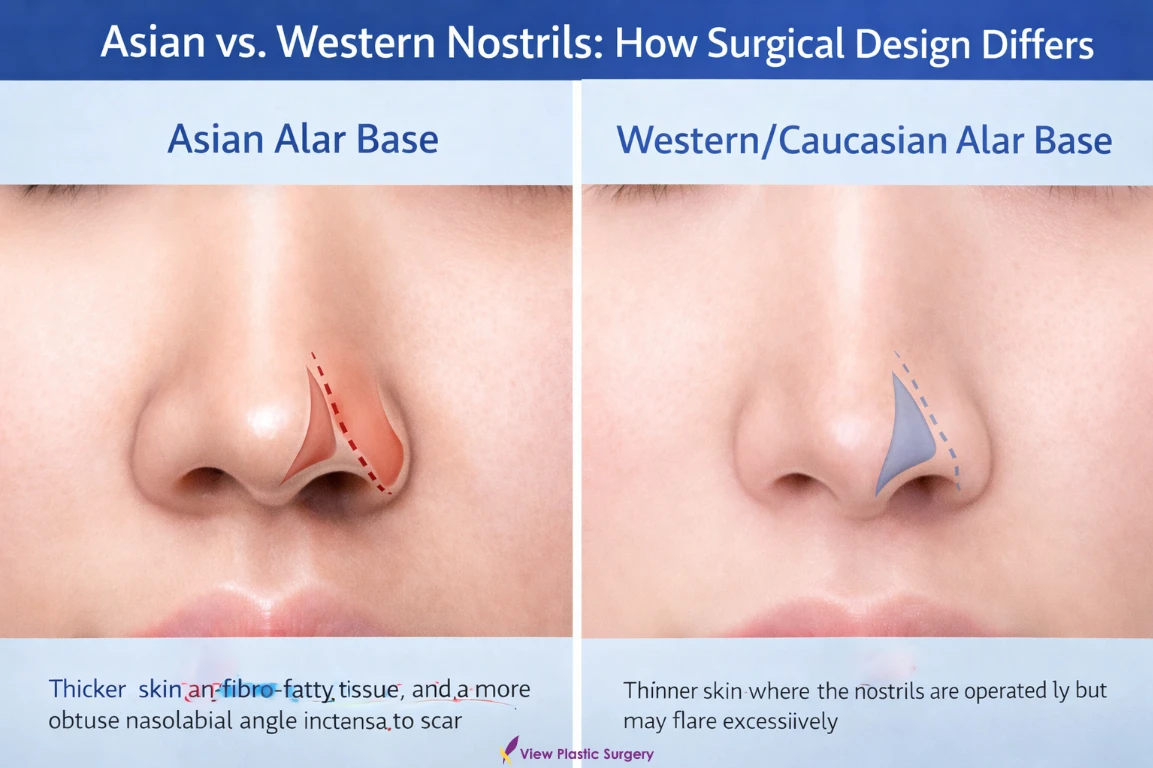
Surgical design is not one-size-fits-all. The approach differs vastly based on ethnicity and anatomical structure.
The Asian Alar Base
Typically characterized by thicker fibro-fatty tissue and a more obtuse nasolabial angle. The goal here is often to reduce the “meatiness” of the wings while creating a more acute angle between the nose and cheeks. The incision often wraps around the curvature to hide the scar in the shadow.
The Western/Caucasian Alar Base
Often involves thinner skin where the nostrils are oriented more vertically but may flare excessively. The focus is on narrowing the sill (the floor) without making the nostrils look “pinched” or affecting breathing. Over-reduction is a major risk here; removing too much tissue can lead to a triangular, unnatural look.
At View Plastic Surgery, our surgeons are experts in multi-ethnic rhinoplasty, ensuring the result harmonizes with your specific facial features.
Procedure Time, Recovery, and Downtime

One of the main reasons foreigners choose standalone Alar Reduction is the manageable recovery timeline.
- Surgical Time: Approximately 30 to 50 minutes.
- Anesthesia: Local anesthesia (with or without conscious sedation).
- Stitch Removal: Typically 5 to 7 days post-surgery.
- Swelling & Bruising: Major swelling subsides within 1 week. Unlike full rhinoplasty, bruising around the eyes is extremely rare because the nasal bones are not fractured.
- Makeup: You can apply makeup to the area immediately after stitch removal to conceal incision lines (which are already red/pink but fading).
How Long Should You Stay in Korea for Alar Reduction?

If you are planning a “medical cation,” scheduling is crucial. While the surgery is quick, proper aftercare ensures the best scarring results.
- Minimum Recommended Stay: 7 Days.
- Itinerary:
- Day 1: Consultation & Surgery.
- Day 2-3: Rest and ice pack cooling (hotel rest, light walking).
- Day 5-7: Stitch removal and final check-up.
While some patients fly out immediately after stitch removal, staying 1-2 extra days allows our medical team to monitor the incision site for any early signs of inflammation. Compared to full rhinoplasty which often requires 10-14 days in-country, this is very travel-friendly. If you have questions about scheduling, contact us via WhatsApp for instant assistance.
Why Korea Is a Top Destination for Alar Reduction Only

Why fly to Korea just for nostril reduction? The answer lies in Scar Management and Design Esthetics.
Korean surgeons perform thousands of alar reductions annually. This high volume has led to the perfection of suturing techniques that minimize scarring—the biggest concern with this surgery. Furthermore, the Korean aesthetic focuses on a “natural refinement.” We avoid the “pinched” look that was common in older rhinoplasty methods.
At View Plastic Surgery, we combine 3D CT scanning technology with artisanal surgical skill to ensure that even a small change to your nostrils results in a powerful improvement to your overall beauty.