



V-line Surgery Seoul: The Ultimate Guide to Facial Contouring and Mandibular Reshaping
Facial aesthetics have evolved beyond simple features to the fundamental structure of the face. In the global landscape of aesthetic medicine, V-line surgery in Seoul has emerged as the gold standard for achieving a balanced, slender, and refined lower face profile. This procedure, technically known as a combination of mandibular angle reduction and genioplasty, requires an intricate understanding of craniofacial anatomy, surgical precision, and advanced diagnostic technology.
At View Plastic Surgery, we recognize that a successful outcome is not just about bone resection but about creating harmony between the skeletal framework and the overlying soft tissues. This guide provides an exhaustive clinical breakdown of the procedure, safety protocols, and the recovery journey for patients seeking the best V-line surgery in Korea.

1. The Aesthetic Philosophy of the V-Line in Korea
The ‘V-line’ refers to the sleek, continuous curve from the ear down to the tip of the chin. Unlike traditional jaw reduction which focused solely on the back of the jaw (the angle), modern Facial Contouring Surgery in Korea addresses the entire lower third of the face. The goal is to eliminate the ‘square’ appearance caused by a prominent mandibular angle and a wide or blunt chin.
Defining the Ideal Lower Facial Proportions
Clinically, the ideal lower face is determined by the ratio of the mid-face to the lower face. A successful V-line procedure aims to achieve a golden ratio where the width of the chin is approximately 0.618 of the width of the mid-face. This involves more than just cutting bone; it involves sculpting the bone to allow for a natural transition that avoids the ‘secondary angle’—a common side effect of poorly executed surgeries where an unnatural step is visible on the jawline.
2. Anatomical Components: Mandible Reduction and Genioplasty
V-line surgery is essentially a synergistic procedure. If one only reduces the jaw angle, the chin may still look wide. If one only performs a genioplasty, the back of the jaw remains bulky. True V-line results require a holistic approach.
Mandibular Angle Reduction (Square Jaw Surgery)
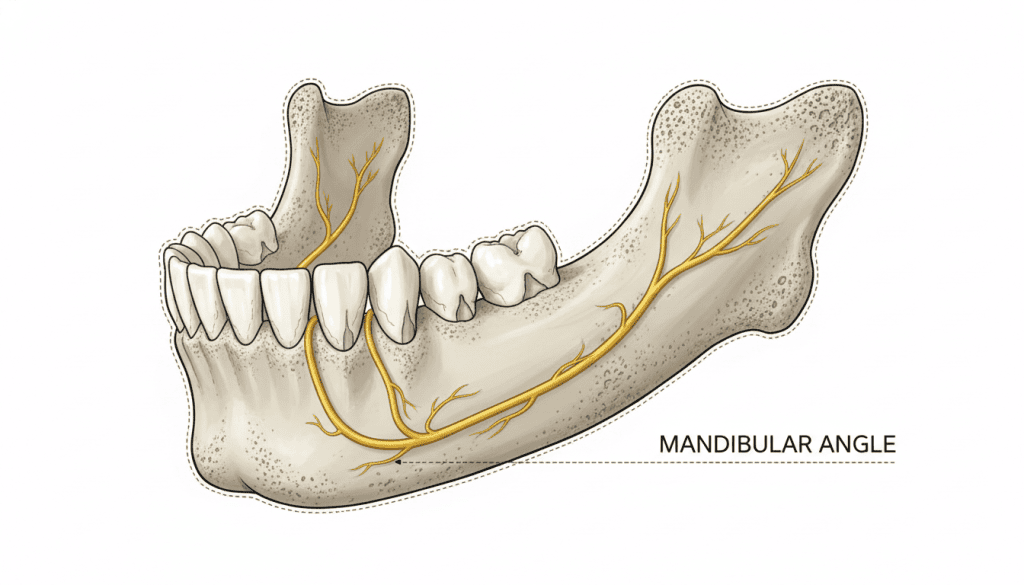
Patients with a wide lower face often present with an overdeveloped mandibular angle (Gonion). Jaw reduction surgery in Seoul involves the precise resection of the prominent bone. However, at View Plastic Surgery, we employ Long-Curve Resection. This technique extends the cut from the back of the jaw all the way to the front, ensuring no sharp transitions and a naturally tapered look.
Genioplasty and the T-Osteotomy Technique
The chin’s width and position define the ‘V’ point. The T-osteotomy is the most versatile technique used in Seoul. It involves making a horizontal and vertical cut in the chin bone, removing a central piece of bone, and then bringing the two remaining sides together. This effectively narrows the chin while allowing the surgeon to move the chin forward or backward to correct receding or protruding chins.
| Surgical Component | Surgical Component | Aesthetic Objective |
|---|---|---|
| Long-Curve Resection | Mandibular Body and Angle | Slimming the side profile and front width. |
| T-Osteotomy | Mental Protuberance (Chin) | Defining the sharpness and width of the chin point. |
| Cortical Bone Resection | Outer Bone Layer | Reducing actual thickness of the jawbone for frontal slimness. |
| Masseter Reduction | Masseter Muscle | Reducing muscle bulk for additional slimming. |
3. Advanced Diagnostics: 3D CT Analysis for Safety
Safety in V-line surgery in Seoul is predicated on accurate visualization. The mandible houses the Inferior Alveolar Nerve, which provides sensation to the lower lip and chin. Damaging this nerve is a significant risk in facial contouring.
At View Plastic Surgery, we utilize 3D CT (Computed Tomography) scans to create a digital roadmap of the patient’s bone structure. This allows our surgeons to:
- Identify the exact pathway of the nerve canal to set a safe ‘limit line’ for bone resection.
- Measure bone density and thickness to determine the feasibility of cortical resection.
- Analyze asymmetrical structures to plan differential cutting paths for both sides of the face.
For a personalized safety assessment, you can book a consultation with our specialists.
4. The Surgical Process: Precision and Customization
Every face is unique, and the best V-line surgeon in Seoul knows that a ‘one-size-fits-all’ approach leads to unnatural results. The surgery is performed under general anesthesia and typically takes 1.5 to 2 hours.
Step-by-Step Breakdown
- Incision: All incisions are made intra-orally (inside the mouth), meaning there are no visible external scars.
- Chin Sculpting: The chin is reshaped first using the appropriate osteotomy (T, V, or M-shape) based on the patient’s chin length and width.
- Jawline Connection: The surgeon then performs the long-curve resection to connect the new chin shape to the jaw angle smoothly.
- Refining the Surface: Cortical bone resection is performed to thin the outer layer of the jawbone, maximizing the slimming effect from the front view.
- Closure: Dissolvable sutures are used, and a compression bandage is applied.
5. Recovery and Aftercare: Managing Swelling
The success of Facial Contouring Surgery in Korea depends heavily on the post-operative period. While the bone is cut during surgery, the soft tissue takes time to drape over the new framework
The Recovery Timeline
- Days 1-3: Peak swelling. Patients are advised to keep their head elevated and use cold compresses. A liquid diet is required.
- Day 7: Major swelling begins to subside. Patients can often return to light activities. Stitches inside the mouth are checked.
- Weeks 2-4: 70-80% of swelling disappears. Normal eating (soft foods) can resume.
- Months 3-6: Residual minor swelling (especially in the chin area) dissipates, and the final ‘V-line’ becomes fully visible.
View Plastic Surgery provides a specialized Post-Operative Care Program including high-frequency therapy, LED deswelling treatments, and ultrasound care to accelerate lymphatic drainage and skin tightening. For real-time recovery tips, contact us via WhatsApp.
6. Safety and Ethics: The View Advantage
When researching V-line surgery Korea cost, safety must be the primary variable. This is achieved through:
- In-house Anesthesiologists: Dedicated specialists monitor patients in real-time throughout the entire procedure.
- Emergency Systems: We are equipped with UPS (Uninterruptible Power Supply) and advanced resuscitation equipment.
- Shadow Doctor Prevention: We guarantee that the surgeon you consult with is the one who performs the surgery, using a real-name surgery system.
7. Factors Influencing V-line Surgery Korea Cost
The cost of V-line surgery in Seoul varies depending on the complexity of the case. Factors include:
- The need for additional procedures like buccal fat removal or masseter reduction.
- The type of osteotomy required for the chin.
- The revision status (previous surgeries making the procedure more complex).
While prices are competitive globally, the true value lies in the specialized skill of Korean surgeons who perform these procedures daily, offering a level of refinement rarely found elsewhere.
Book a complimentary consultation today to get a tailored quote for your specific needs.